
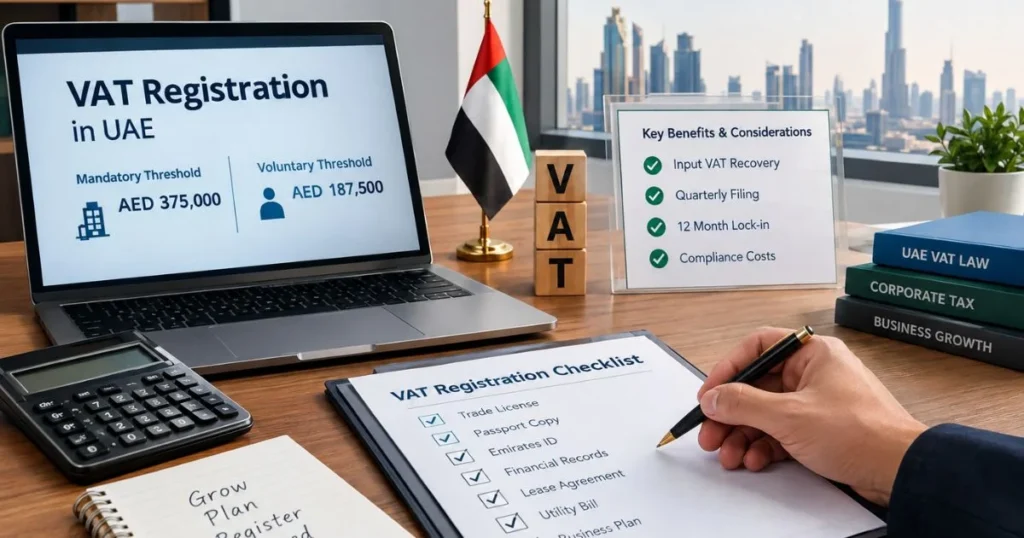
A business below the AED 375,000 mandatory VAT threshold doesn’t have to register, but it can choose to once turnover, imports, or expenses cross AED 187,500. That choice comes with real trade offs: recoverable input VAT on one side, quarterly filing and a 12 month lock in on the other. This article walks through who benefits, who should wait, and what the Federal Tax Authority actually requires.
What Voluntary VAT Registration Is Under UAE Law
Voluntary VAT registration lets a business join Value Added Tax before it hits the AED 375,000 mandatory threshold. The Federal Tax Authority sets a lower entry point: the AED 187,500 voluntary threshold. This applies to taxable supplies, taxable imports, or taxable expenses over a rolling 12 month period, or a next 30 day forward test. UAE VAT law, under the Decree Law, separates standard rated supplies, zero rated supplies, and exempt supplies.
Once approved, the business gets a Tax Registration Number. This number confirms the business meets mandatory VAT registration rules or chooses to register early. It applies to sales inside the UAE and goods brought in. The rule gives smaller businesses a real choice, not just a future deadline.
Who Is Eligible to Register Voluntarily
The Taxable Supplies and Imports Test
A business passes the taxable supplies test when its standard rated supplies, zero rated supplies, or import VAT cross the AED 187,500 threshold. The FTA checks this over a rolling 12 month turnover, or through a forward looking 30 day test. Businesses using the reverse charge mechanism or gaining related party supplies through a business acquisition count these toward eligibility too.
The Taxable Expenses Test for Pre-Revenue Startups
A pre-revenue startup qualifies through the taxable expenses test instead. Fit out cost, setup cost, and stock purchase VAT all count as input VAT on expenses. During the ramp up period, heavy capital expenditure proves real activity. Business plan evidence shows genuine intent to make taxable supplies, even before any sale happens.
Evidence the FTA May Request to Confirm Genuine Business Activity
The FTA may ask for signed contracts, signed proposals, or purchase orders as proof. Supplier invoices, a trade license, and a business plan support the claim. Owners submit Emirates ID, a passport copy, and Power of Attorney where needed. Financial records, a lease agreement, and a utility bill confirm the address and activity.
Weighing Input VAT Recovery Against Compliance Cost
Recoverable VAT vs Admin Overhead
At the 5% standard VAT rate, an AED 150,000 setup and stock cost gives an AED 7,500 recoverable VAT. This recoverable input VAT calculation sets one side of the break even comparison. The other side is quarterly filing cost, accounting software cost, VAT Return Form 201 work, and the record keeping burden.
When the Numbers Favor Registering Early
Registering early makes sense with high VAT bearing setup cost. A B2B client base helps, since a VAT registered corporate customer reclaims VAT charged. Significant capital expenditure signals real spending. A growth oriented company or export driven business with large recoverable input VAT gains the most from early registration.
When Waiting for the Mandatory Threshold Makes More Sense
A business with low taxable turnover and minimal VAT recoverable expense should wait. A consumer facing business faces B2C pricing sensitivity, since shoppers can’t reclaim VAT. Without a small compliance overhead justification, registering early just adds unnecessary administrative work for no real gain.
How Voluntary Registration Applies to Dubai Free Zone Businesses
Mainland vs Free Zone Businesses Under the Same Thresholds
A mainland company and a free zone company both use the same AED 187,500 threshold and AED 375,000 threshold. The trade license type doesn’t change these numbers. What counts is taxable supplies within UAE and free zone taxable activity, calculated the same way for both business types.
FTA Designated Zones and Why the Calculation Changes
An FTA designated zone, like DMCC or JAFZA, changes the math. Goods transferred within designated zone areas often count as an out of scope supply. This depends on customs control and a fenced perimeter requirement. Businesses inside these zones need correct designated zone VAT treatment before counting turnover toward either threshold.
What Registering Voluntarily Commits You To
What Happens If Turnover Falls Below the Threshold Mid Year
A turnover decline doesn’t end the commitment early. The rule causes ineligibility for early deregistration during the first year. The business keeps a continued VAT charging obligation and a continued VAT filing obligation. This 12 month waiting period means real compliance cost persistence, even with falling sales.
Deregistration Conditions Once the 12 Months Pass
After 12 months, a business can submit a VAT deregistration application. This applies once turnover drops below the AED 187,500 deregistration threshold, or after ceasing taxable activity. The EmaraTax deregistration request starts the process. FTA approval for deregistration usually follows a 20 business day review.
Which UAE Businesses Voluntary Registration Tends to Suit
B2B, Export Facing, and Government Supplier Businesses
A B2B customer often prefers working with a registered supplier. Government entity procurement and corporate buyer preference both favor this setup. Registration gives tax invoice recoverability and a real credibility signal, backed by the TRN display requirement. An exporter making zero rated export sales benefits most.
Startups With Significant Setup or Fit Out Costs
Heavy fit out expenditure, office equipment cost, and initial stock purchase add up fast. A physical location setup often means large supplier invoice VAT bills. Registering early allows sunk cost avoidance during the pre-revenue ramp up, turning that VAT into money the business gets back.
How Voluntary VAT Registration Connects to Your UAE Corporate Tax Position
Voluntary VAT registration often lines up with a business’s UAE Corporate Tax stage too. A business nearing the VAT threshold often nears the Corporate Tax registration threshold as well. This creates a real growth stage compliance overlap, not two separate events.
Some smaller businesses still qualify for Small Business Relief, which eases the Corporate Tax registration obligation. Either way, gaining taxable person status for VAT calls for financial record alignment across both taxes. The Federal Tax Authority reviews both filings using the same business records.
Talking to an FTA Certified Tax Agent Before You Decide
Documents the FTA Requests for Voluntary Registration
The FTA asks for a valid trade license, a passport copy, and an Emirates ID. A Power of Attorney applies where an agent signs on the owner’s behalf. Applicants also submit a bank account IBAN letter, financial records, a lease agreement, a utility bill, and proof of turnover or expenses.
What Happens After You’re Approved
Approval brings Tax Registration Number issuance, a unique 15 digit TRN. From that date, the 5% VAT charge obligation applies to taxable sales. The business follows the tax invoice requirement and a quarterly return schedule. Everything runs through the EmaraTax dashboard, including all FTA correspondence.
FAQs
Can I register voluntarily if my turnover is below AED 187,500?
No. The AED 187,500 minimum applies to the taxable supplies threshold or taxable expenses threshold, checked over 12 months or through a 30 day forward expectation.
Can I deregister early if voluntary registration turns out to be the wrong call?
No. A 12 month lock in period applies first. After that, a business submits a deregistration application, subject to FTA approval requirement before it takes effect.
Does voluntary VAT registration affect my UAE Corporate Tax obligations?
Not directly. But nearing the Corporate Tax registration threshold often means gaining taxable person status around the same time, sometimes alongside Small Business Relief eligibility.
Can freelancers and sole establishments register voluntarily?
Yes. Freelancer eligibility and sole establishment eligibility follow the same rule as any business, based on AED 187,500 threshold applicability to their supplies or expenses.
How long does FTA approval for voluntary registration take?
Approval typically takes around 20 business days during the EmaraTax review period, assuming the application meets the full document completeness requirement.
Need Help Deciding If Voluntary VAT Registration Is Right for Your Business?
Assurance Corps holds FTA Certified Tax Agency status under Tax Agency Number TAN 30019921. A certified Tax Agent, TAAN 20065132, reviews your case directly. Book a free 30 minute consultation and get a written scope summary with a clear VAT registration recommendation.