
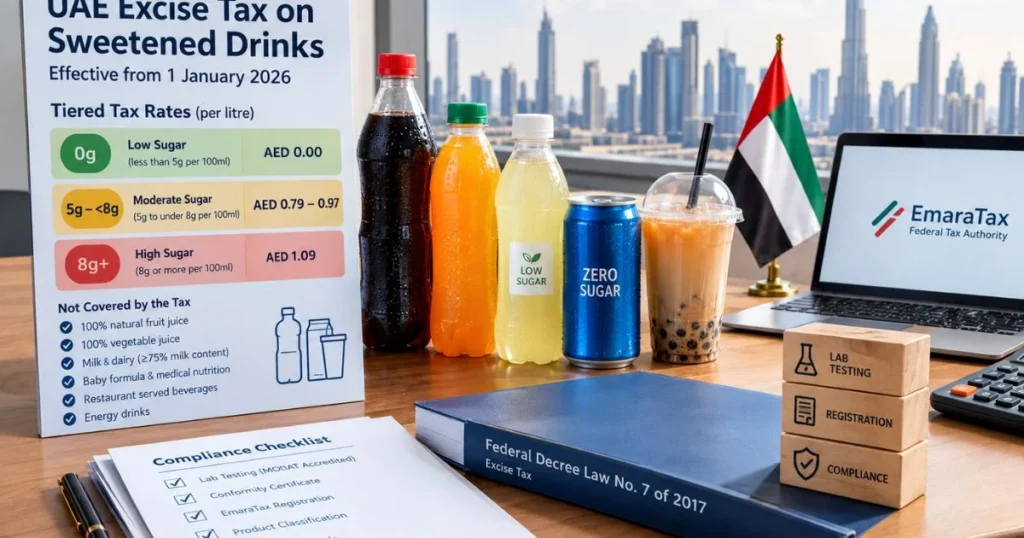
Starting January 1, 2026, the UAE taxes sweetened drinks by sugar content instead of price. The Federal Tax Authority replaced the old flat 50% rate with a tiered volumetric model under Cabinet Decision No. 197 of 2025. This guide covers the new rate tiers, what counts as a sweetened drink, and the compliance steps every UAE business needs before its next excise filing.
What the UAE’s New Excise Tax on Sweetened Drinks Means
The Federal Tax Authority now taxes sweetened drinks by sugar content, not price. Cabinet Decision No. 197 of 2025 replaced the old flat 50% excise tax with a tiered volumetric model. This model charges tax based on sugar content per 100ml, covering added sugar and artificial sweeteners.
Federal Decree Law No. 7 of 2017 set the legal base for excise tax in the UAE. The change follows the GCC Unified Excise Tax Agreement and replaces Cabinet Resolution No. 52 of 2019. It supports health driven taxation, pushing product reformulation and consumption reduction as part of wider public health policy.
UAE Sugar Tax Rates for 2026: The Three Tiers
Low sugar and artificial sweetener drinks (0 AED per litre)
Drinks with less than 5g sugar per 100ml pay AED 0 per litre. This covers the low sugar tier and drinks using only artificial sweeteners, like aspartame, sucralose, or stevia. Most diet soda falls here. Low natural sugar content keeps a drink tax exempt.
Moderate sugar drinks: 5g to under 8g per 100ml
The moderate sugar tier covers 5g to under 8g per 100ml. This band pays AED 0.79 per litre under most published rates. The Federal Tax Authority’s own page states AED 0.97 per litre instead. A 500ml iced tea with 6g sugar shows this per-litre calculation in practice.
High sugar drinks: 8g or more per 100ml
The high sugar tier applies to drinks with 8g or more per 100ml. This is the highest sweetened drink band, taxed at AED 1.09 per litre. Most carbonated drinks now fall here. A 1.5 litre cola example shows the full charge. No certificate brings automatic high sugar classification.
AED 0.79 or AED 0.97? Resolving the UAE’s Conflicting Published Rates
What the Federal Tax Authority’s own page states
The Federal Tax Authority’s official page on tax gov lists AED 0.97 per litre for the medium sugar category. This page, titled Calculating Excise Tax According To A Tiered Volumetric Model For Sweetened Drinks, cites Cabinet Decision No. 197 of 2025 directly. It also references Public Clarification EXTP013. The page shows a last updated date of Dec 31, 2025.
Why most secondary sources cite a different figure
Most secondary sources list AED 0.79 per litre for the same tier instead. This figure likely comes from a pre-final decision version of the rate. Early syndicated news reporting picked it up before the final rule was published. That figure then spread across many outlets, creating a rate rounding variance that still appears today.
Which rate businesses should use for compliance
Businesses should use the rate on the Federal Tax Authority’s official page for compliance today. This means direct tax gov verification before filing any return. An FTA Certified Tax Agency can give Tax Agent confirmation on the correct EmaraTax registration rate. A written scope summary protects a business from the compliance risk of misquoting the wrong rate.
What Counts as a Sweetened Drink Under FTA Rules
A sweetened drink definition covers any ready to drink beverage with added sugar or other sweeteners, including honey. It also covers concentrates, powders, gels, and extracts that turn into a drink. Carbonated drinks now fall under this same reclassification. Natural sugar with no added sweetener stays outside the definition.
Some drinks skip this tax entirely. 100% natural fruit juice and 100% vegetable juice don’t count. Milk and dairy products with 75% milk content stay exempt, along with baby formula, follow up formula, and medical nutrition products for special dietary use under GSO 654 and GSO 1366. Restaurant served open container beverages and energy drinks get the same exclusion.
Compliance Steps for UAE Businesses Selling Sweetened Drinks
MOIAT accredited laboratory testing and the Conformity Certificate
Businesses need a sugar and sweeteners content certificate from a MOIAT accredited laboratory. This is the Emirates Conformity Certificate, backed by the National Accreditation Department and Emirates International Accreditation Centre. Labs run added sugar verification through flavour specific testing. One single certificate can cover multiple sizes of the same drink.
Registering sweetened drinks through EmaraTax
Registration happens through the EmaraTax digital tax services platform. Businesses submit a product registration update with a tax registration number (TRN). This falls under standard excise goods registration, covering each beverage SKU registration separately. A 30 day registration window applies once a business becomes liable, and full registration documentation must go with it.
Automatic high sugar classification if no certificate is filed
No certificate means automatic high sugar classification by default. A missing lab certificate triggers the AED 1.09 per litre default rate. Businesses avoid this with a compliant lab report on file. Once submitted, the classification update runs through a normal reclassification process.
How the 2026 Tax Applies Across Dubai’s Free Zones and Mainland
The new rate applies to every mainland UAE business and every free zone authority, including DMCC, JAFZA, and DIFC. Each producer, importer, stockpiler, and warehouse keeper in a Designated Zone must register the same way.
Stockpiler qualification rules apply equally across zones, as set out in Public Clarification EXTP003. A transitional relief period runs January to June 2026. Businesses can claim an unsold stock adjustment through a refund and adjustment claim for the tax difference on excess stock.
FTA Enforcement on Sweetened Drinks in 2026
Inspection and seizure figures reported by the FTA
The Federal Tax Authority ran 103,680 inspection visits in the first half of 2026. These checks found AED 174 million in tax liabilities, tied to 8.5 million non compliant excise products seized. A separate Federal Tax Authority and Dubai Police joint operation seized another 3.5 million excise goods packages.
Penalty exposure for unregistered or misclassified products
Unregistered excise goods carry an AED 10,000 late registration penalty. A separate misclassification penalty applies under the administrative penalty schedule. Non compliant beverage seizure can follow either failure. Missing paperwork also brings an automatic high sugar reclassification cost by default.
What UAE Businesses Should Do Before Their Next Excise Filing
Review product sugar content and reformulation options
Start with a full sugar content audit across every product line. A clear reformulation strategy can support real sugar reduction. This often brings a product classification shift into a lower tier. A lower tier means a direct tax liability reduction.
Confirm registration and certificate status through EmaraTax
Run an EmaraTax registration status check before filing. Confirm Conformity Certificate validity and complete any needed registration renewal. Submit a product update submission for any changed formula. Keep certificate expiry tracking in place to avoid gaps.
FAQs
What is the current UAE excise tax rate for sweetened drinks in 2026?
The excise tax rate 2026 runs AED 0 for low sugar, AED 0.79 to AED 0.97 for moderate sugar, and AED 1.09 per litre for high sugar drinks.
How do I know if my beverage is classified as low, moderate, or high sugar?
Sugar classification depends on total sugar content per 100ml, confirmed through lab testing. Under 5g is low, 5g to 8g is moderate, 8g or more is high.
What happens if I don’t submit a MOIAT lab certificate for my sweetened drink?
Without a MOIAT lab certificate, the Federal Tax Authority automatically places your drink in the high sugar tier. This means paying AED 1.09 per litre until you submit one.
Are all sugary drinks covered by the new tiered excise tax?
Tiered excise coverage excludes natural fruit juice, milk drinks with 75% milk, baby formula, and medical nutrition products. Energy drinks stay under their own separate 100% rate.
Do free zone companies need to register separately for excise tax on sweetened drinks?
Free zone registration follows the same rules as mainland businesses. Producers, importers, and stockpilers in DMCC, JAFZA, or DIFC all register through EmaraTax.
Don’t Let a Misclassified Product Cost You AED 1.09 Instead of AED 0
Assurance Corps holds FTA Certified Tax Agency status under TAN 30019921. Every filing runs through a licensed Tax Agent (TAAN 20065132). Book a free 30 minute consultation and get a written scope summary within 24 hours. Start your excise tax planning and compliance service through WhatsApp consultation booking today.