
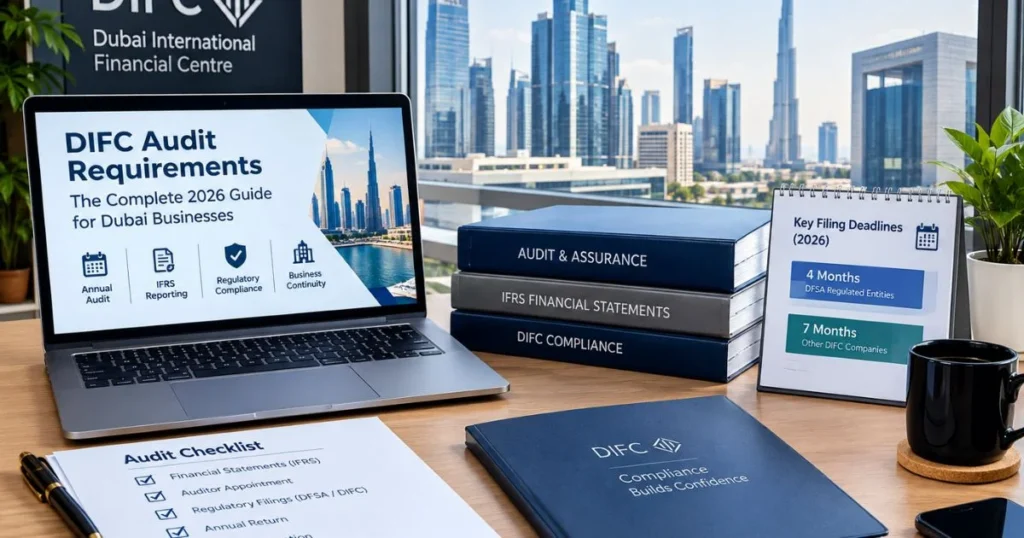
A DIFC audit is an annual, mandatory review of a company’s financial statements. It applies to entities registered in the Dubai International Financial Centre. DFSA regulated firms must always complete an audit. They file within four months of their financial year end. Most other DIFC companies file within seven months. Some qualify for the small company exemption instead. Every Qualifying Free Zone Person must still hold an audit. This keeps its 0% corporate tax rate, regardless of size.
What Is a DIFC Audit
A DIFC audit is an annual check of a company’s financial records inside the Dubai International Financial Centre. The DIFC Companies Law makes this an annual mandatory audit for most registered firms. An approved auditor reviews the books and confirms they give a true and fair view. This falls under the DIFC free zone’s own independent regulatory framework, built on common law jurisdiction.
The audit follows International Financial Reporting Standards. A DIFC registered company must file IFRS compliant financial statements after each financial year end. This statutory audit covers standalone financial statements or consolidated financial statements, based on structure. The DIFC Companies Regulations set this financial reporting obligation apart from mainland UAE audit rules. It runs as its own free zone audit regime.
Who Regulates DIFC Audits
Dubai Financial Services Authority (DFSA)
The DFSA is the independent regulator for financial services firms in DIFC. It sets prudential rules and gives DFSA oversight to regulated firms. Firms need a DFSA licence, ranging from Category 1 to Category 4 licence. This covers banks, investment firms, insurance companies, and asset managers. Check any firm on the DFSA public register at dfsa.
DIFC Authority (DIFCA) and DIFC Registrar of Companies
The DIFC Authority handles DIFC ecosystem administration. DIFCA works with the DIFC Registrar of Companies for company registration. Every entity, including a non regulated commercial company, files an annual return filing. This ensures DIFC Companies Law compliance through the DIFC portal. A registrar email confirmation follows once the beneficial ownership declaration, or UBO, is submitted.
DFSA Registered Auditors vs DIFC Registered Auditors
A DFSA registered auditor holds a DFSA registration certificate for firms doing licensed financial services activities. A DIFC registered auditor needs MOE auditor approval and a DIFC registration certificate instead. This dual registration split separates financial services firms from non regulated commercial companies. A holding company, trading company, consulting firm, professional services firm, technology company, or family office uses a DIFC auditor, not DFSA.
Which DIFC Companies Must Complete an Annual Audit
DFSA Regulated Financial Services Firms
A DFSA licensed firm always needs a mandatory audit regardless of size. This covers banking and credit, including accepting deposits and providing credit. It also covers investment services, like dealing in investments, arranging deals in investments, and managing assets. Other activities include advising on financial products, fund management, and a collective investment fund. Insurance intermediation and Category 4 investment management apply here too, alongside any asset management firm.
Small Company Exemption for Private DIFC Companies
DIFC gives a small company exemption to some private firms. A private company exemption applies below annual turnover USD 5 million, with 20 shareholders or fewer. Other rules use revenue AED 12 million threshold, assets AED 6 million threshold, and 50 employees threshold. This follows two of three criteria. A firm that meets one criteria no mandatory audit applies files management accounts instead. A firm that meets two criteria mandatory audit applies cannot submit unaudited financial statements.
Why Qualifying Free Zone Person (QFZP) Status Still Requires an Audit
A Qualifying Free Zone Person keeps its QFZP status through an audit. This status gives a 0% corporate tax rate on qualifying income from qualifying activities. Non qualifying income still faces the 9% standard corporate tax rate. QFZP firms must also meet an adequate substance requirement. The UAE Corporate Tax Law, under Federal Decree Law No. 47 of 2022, sets the audited financial statements requirement. The audit exemption does not apply to QFZP firms, even small ones.
DIFC Audit Filing Deadlines in 2026
Four Month Deadline for DFSA Regulated Entities
A DFSA regulated entity deadline falls four months from financial year end. Firms must file audited financial statements DFSA by this date. They also submit a Prudential Information Bulletin, or PIB, and Prudential Investment Business, or PIN, reports. These come as quarterly PIB PIN and annual PIB PIN filings. Some firms add a client money audit report and regulatory capital verification. An AML compliance report may apply too.
Seven Month Deadline for Other DIFC Companies
A DIFC commercial company deadline runs seven months from financial year end instead. This applies to non regulated company deadline filings sent through DIFC Registrar of Companies filing. A firm with financial year end December 31 files by July. A firm with a financial year end March 31 files by October. This shows how the filing deadline varies by year end date across DIFC companies.
Documents a DIFC Approved Auditor Will Require
Corporate and Incorporation Records
A DIFC auditor first asks for corporate and incorporation records. This starts with the trade licence and Certificate of Incorporation. Firms also provide the Memorandum of Association and Articles of Association. Auditors need shareholder details, director details, and past board resolutions. A current beneficial ownership declaration completes this document set.
Accounting, Banking, and Financial Records
Next, the auditor reviews accounting, banking, and financial records. This includes the trial balance, general ledger, and journal entry register. Firms submit sales invoices, purchase invoices, and expense records too. Bank statements and bank reconciliation statements confirm cash positions. Auditors check draft financial statements, the fixed assets register, and both the accounts receivable schedule and accounts payable schedule. Loan and liability details and related party transaction details come next, alongside major contracts and agreements.
Penalties for Missing DIFC Audit Requirements
License Renewal and DIFC Registrar Consequences
Missing a DIFC audit gets a firm’s license renewal blocked. Companies also face a licence amendment restriction on their trade licence. Directors cannot apply for new visas and cannot renew employee visas. The DIFC Companies Law penalty provision sets fines up to USD 25,000 for an improper accounting records penalty. This can lead to director personal liability and even director disqualification.
DFSA Enforcement Penalties for Regulated Entities
A regulated firm faces DFSA enforcement action for non compliance. A first breach starts at USD 2,500 first breach, rising to USD 15,000 repeated contravention. The DFSA can issue a senior management prohibition order against individuals. Firms risk public censure, DFSA licence suspension, or full DFSA licence withdrawal. An authorised individual restriction may also apply to responsible staff.
How to Prepare for a DIFC Audit in Dubai
Confirming Whether Your Company Is Exempt
Start with a small company exemption check before assuming anything. Run the two of three criteria assessments on your accounts. Add a DFSA regulated status check and a QFZP status confirmation. This means a full revenue assets employee count review each year. Many firms make the exemption assumption mistake without checking first.
Choosing a DIFC Registered Auditor
Check the DIFC approved auditors list or the DFSA register of auditors first. Always verify auditor registration before signing an engagement letter. Look for industry experience and clear communication throughout the process. Engage the auditor 90 days before year end to avoid delays. Assurance Corps holds FTA Certified Tax Agency status and EAAA member standing. The firm brings 15 years UAE market experience with DMCC to JAFZA to DIFC coverage.
FAQs
Is Every DIFC Company Required to Be Audited?
Not every DIFC company needs an audit. The small company exemption applies to smaller private firms. DFSA regulated entities are always audited, since they always meet the mandatory audit criteria.
What Happens if a Zero Activity DIFC Company Misses the Filing Deadline?
A zero activity company still faces penalties for late dormant company filing. Even zero figure financial statements need submission on time. The late filing penalty applies regardless of activity, creating real licence renewal risk.
How Long Does a DIFC Audit Usually Take?
Audit duration varies by company size. A three to six weeks SME audit is typical. Larger firms need eight to twelve weeks complex entity review, since the audit timeline depends on record quality and management representation cooperation.
Do I Need a DFSA Registered Auditor or a DIFC Registered Auditor?
A DFSA registered auditor for regulated firms handles licensed activities. A DIFC registered auditor for commercial companies covers everyone else. Licensed financial services activity determines requirement, so a holding company with non regulated status uses DIFC auditors.
Does a DIFC Audit Affect My UAE Corporate Tax Filing?
Yes. Audited financial statements support tax filing and taxable income determination. Since QFZP 0% rate requires audit, audited accounts also protect corporate tax return accuracy during Federal Tax Authority review.
Need Help With Your DIFC Audit
Assurance Corps offers complete DIFC audit services for companies across Dubai. The firm holds FTA Certified Tax Agency status under Tax Agency Number TAN 30019921, plus EAAA member standing. Visit the Dubai office, start a WhatsApp consultation, or book a free consultation today to check your DIFC audit requirements.