
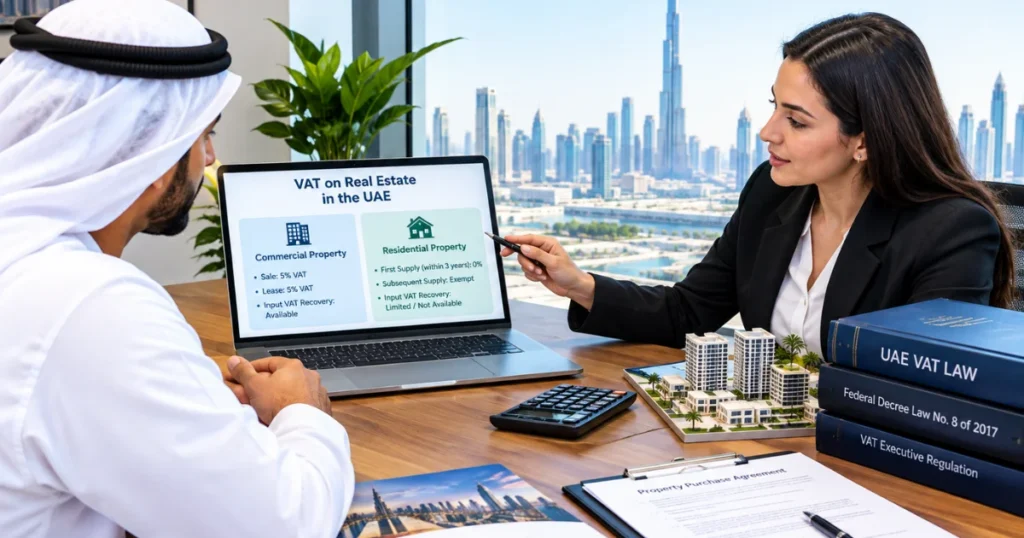
Commercial property in the UAE carries 5% standard rated VAT on every sale and lease. Residential property gets zero rated treatment on its first supply, then turns exempt after that. Bare land stays exempt, but developed land does not. The Federal Tax Authority sets these rules under Federal Decree Law No. 8 of 2017, and the correct category depends on the property’s type, use, and timing, not its price.
What VAT Category Applies to a UAE Property
A UAE property’s VAT treatment falls into one of three groups: standard rated supply, zero rated supply, or exempt supply. The Federal Tax Authority sets this under Federal Decree Law No. 8 of 2017 and the VAT Executive Regulation. The category depends on the nature of the property and the point of supply, not the price.
A taxable person must confirm the intended use first. This classification decision happens before a sale or lease closes. It decides the tax point, the rate charged, and what a taxable supply costs the buyer.
VAT on Commercial Property in the UAE
VAT on the Sale of Commercial Property
A commercial property sale carries standard rated sale treatment at 5%. The VAT registered seller charges output tax on the sale price and issues a tax invoice. Federal Decree Law No. 8 of 2017 sets this rule. A sale can qualify as a transfer of a going concern, known as TOGC, outside VAT scope.
VAT on Commercial Property Leases
A commercial lease counts as taxable rent under UAE law. The landlord charges 5% on rent, and the VAT registered tenant pays it. Every lease agreement needs a tax invoice for commercial rent collected. Service charges tied to the lease also carry VAT at the same rate.
Input VAT Recovery for Commercial Owners and Tenants
Input tax recovery applies when costs support taxable business activity. Owners and tenants claim recoverable input tax as an input tax credit on related expenses. This covers maintenance costs, legal fees, and repair costs. Recovery turns VAT into a cash flow cost instead of a lost expense.
VAT on Residential Property in the UAE
First Supply of Residential Property Within Three Years
A first supply of new housing gets zero rated at 0% treatment. This applies to a developer’s off plan sale, the first sale, or the first lease within three years of the completion date. The original buyer pays no VAT. Construction input tax recoverable status stays open for the developer on this sale.
Subsequent Residential Sales and Leases
A subsequent supply counts as exempt supply in the resale market. A second owner selling in a later resale charges no VAT charged on the price. This creates blocked input tax for the seller. Related costs carry input tax not recoverable status under this exempt category.
What Counts as a Residential Building Under FTA Rules
The residential building definition comes from Article 37. It covers property built for human occupation, including an apartment occupied as principal residence, student accommodation, staff accommodation, a nursing home, or an orphanage. A hotel apartment excluded, a serviced apartment excluded, and any hotel excluded fall outside this definition. A structure not fixed to ground does too.
Short Term Residential Lets Treated as Commercial
A short term let gets commercial treatment under UAE VAT rules. A lease under six months with no Emirates ID on file applies to a non resident tenant. This covers a holiday home, an Airbnb rental, or a Booking listing. Article 43(1) sets a standard rated at 5% for these stays.
Bare Land and Real Estate in Dubai’s Designated Zones
Bare Land Versus Developed Land
Bare land is an undeveloped plot with no structure on it. It stays exempt from VAT under current land classification rules. Developed land carries partially completed works or civil works on the ground. Once building starts, the plot shifts to standard rated developed land status at 5%.
Dubai Land Department Transfer Fee Treatment
The Dubai Land Department charges a transfer fee on every title transfer. This 4% transfer fee applies to the property price plus VAT element, not the base sale price alone. The land registry records this fee at the point of transfer. Buyers should confirm the exact rate before closing.
Property Supplies in a Designated Zone
A designated zone follows different VAT rules than the mainland. Property in a free zone like JAFZA, DMCC, or DIFC can fall outside the scope of VAT in specific cases. A reverse charge mechanism may apply to certain transfers instead. Each zone sets its own conditions for this treatment.
Mixed Use Properties and Input VAT Apportionment
How Shared Input VAT Is Apportioned
An apportionment method splits VAT between commercial and residential use. Owners choose a floor area split or a value based split for shared services. This sets a periodic recovery percentage for each part of the building. An annual wash up corrects the apportionment calculation at year end.
Common Apportionment Mistakes to Avoid
An unapproved apportionment formula creates risk during an FTA audit. Owners sometimes apply an inconsistent ratio across different tax periods. A full VAT recovery claim on shared costs without a split raises red flags. An undocumented apportionment method leaves no proof for the tax authority to check.
The FTA Real Estate Input Tax Apportionment Guide
The Federal Tax Authority publishes the Input Tax Apportionment Real Estate Guide for mixed use owners. This guide sets the official apportionment methodology for split use buildings. It also covers the Capital Assets Scheme for high value property. Owners can find full detail on the tax gov guides and references page.
How to Confirm the VAT Treatment of Your UAE Property
A classification decision starts with the property’s intended use. Owners check this before a sale or lease, not after. The Federal Tax Authority lists every FTA registered Tax Agent in its public FTA Tax Agent directory.
Each agent holds a verified Tax Agency Number for client work. A property classification decision confirmed early avoids errors on the tax invoice. A short consultation with a registered agent settles the category before contracts close.
FAQs
Is VAT charged on selling a villa in Dubai?
A villa sale in Dubai depends on timing. The first sale within three years of completion gets zero rated treatment under Article 45(9). Later resales stay exempt under Article 46(2).
How do I know if my building counts as commercial or residential?
Building classification follows Article 37 of the VAT law. Residential buildings serve human occupation, like apartments or villas. Any other structure, including offices and retail space, counts as commercial.
Does a serviced apartment in the UAE pay VAT?
A serviced apartment pays standard rated VAT at 5%. Article 37(2)(c) excludes it from the residential building definition. Hotel style services place it in the commercial category instead.
Do I pay VAT on bare land in the UAE?
Bare land stays exempt from VAT under Article 46(3). This applies only to undeveloped plots with no structure or civil works present on the site.
How does VAT apply to a mixed use building?
A mixed use building splits VAT treatment by section. The commercial portion carries standard rated VAT. The residential portion follows separate rules, and owners apportion shared costs between both.
Get VAT Planning and Compliance Help
VAT rules on UAE real estate change by property type, timing, and location. A wrong classification costs money at the point of sale or during an FTA audit. Assurance Corps holds FTA registered Tax Agent status, with a verified Tax Agency Number on file with the Federal Tax Authority.