
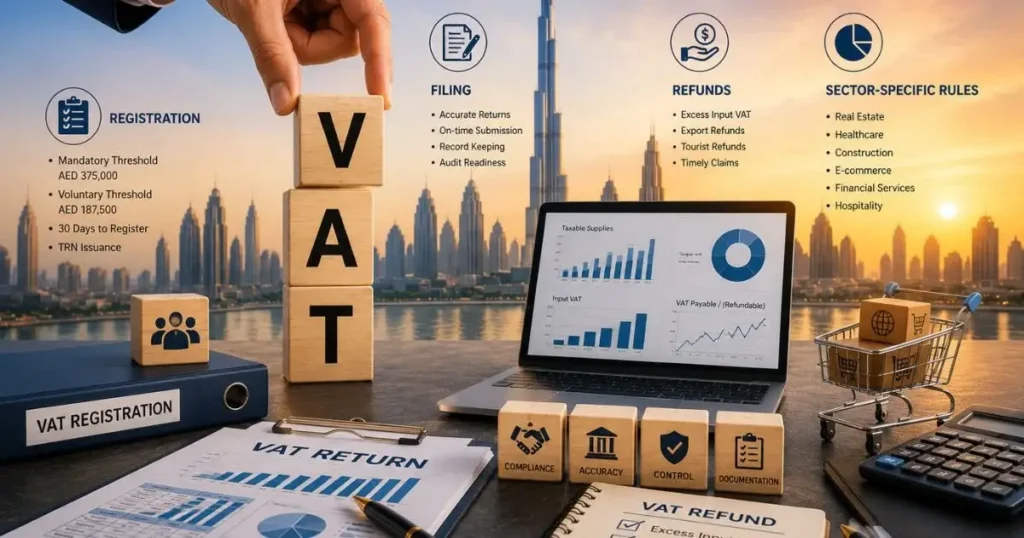
Charging 5% on your invoices is not the same as being VAT compliant. Real compliance means knowing if you must register, applying the right VAT treatment on every sale and recovering the input tax you’re owed. It also means filing accurate returns, keeping proper records and following rules that shift by sector. Miss one piece and the whole chain breaks down fast.
This guide walks through the full VAT journey a UAE business actually faces. We cover registration thresholds, rates, refunds, filing and audit readiness in one place. Real estate, healthcare, construction and e-commerce each carry their own twist on the same law. By the end you’ll know exactly where your business stands and what comes next.
Do You Need to Register for VAT?
AED 375,000 in taxable supplies over 12 months is the line that matters. Once you cross it, registration is no longer a choice. There’s also a voluntary threshold at AED 187,500, which gives smaller businesses the option to register early. A lot of startups go this route for a reason. It lets them reclaim VAT on rent, software and consulting fees. Here’s a trap that catches new business owners often. Zero rated supplies still count toward your threshold, even though you charge no VAT on them. An exporter with AED 600,000 in export revenue must register, despite collecting nothing. Once you cross AED 375,000, you get 30 days to submit your registration.
Miss that window and the Federal Tax Authority charges a flat AED 10,000 penalty. Worse, your VAT liability gets backdated to the day you crossed the threshold. Common candidates for mandatory registration include retailers, consultants, contractors and importers. Freelancers and content creators aren’t flying under the radar anymore. Not once their income starts climbing. The question that trips most people up isn’t whether to register. It’s when. Check your rolling 12 month taxable turnover first, not just this year’s total. If you’re already near AED 375,000, register before the threshold forces your hand. Waiting rarely saves money once penalties and backdated tax enter the picture.
VAT Registration and Compliance Lifecycle
Choosing the Right Registration Option
Registration isn’t always a single company filing alone. Two or more related businesses can form a VAT group registration under Article 14. Each entity needs a UAE presence and shared ownership or control. A tax group then files as one single taxable person, not several. Deregistration applies once your taxable supplies fall below AED 187,500 for 12 straight months. You get 20 business days to apply once that condition hits. Skip it and penalties stack up fast, starting at AED 1,000 with monthly additions.
Once approved, the FTA issues cancellation from the last day of that tax period. Every registered business receives a Tax Registration Number, known as a TRN. This number appears on every invoice, return, and official filing you submit. Losing track of your TRN status creates real problems during bank reviews. We always tell clients to keep this number visible in every accounting system.
Ongoing VAT Compliance Responsibilities
Registration is just the starting line, not the finish. You must maintain accurate accounting records covering every taxable transaction you make. Compliant tax invoices need your TRN, the correct VAT amount and a clear description. Get the details wrong and you’ll end up with rejected invoices and customers who lose patience fast.
There are also record retention rules that require you to keep documentation for a set number of years, so it helps to build a simple compliance calendar for filing dates, payment dates, and renewal deadlines. FTA obligations don’t pause just because your business gets busy elsewhere. Staying organized here saves real stress once audit season arrives.
Understanding VAT Rates and Taxable Supplies
Most goods and services in the UAE are taxed at the standard 5% rate. Zero rated supplies are taxed at 0%, but you can still recover input tax on them, which makes them worth understanding properly. Exports and certain health care services often fall into this zero rated category. Exempt supplies work differently, charging no VAT and blocking input tax recovery entirely. That difference trips up more business owners than any other VAT rule. A zero rated sale keeps your recovery rights intact, an exempt sale removes them.
Get this classification wrong and your VAT return understates or overstates your liability. We check this distinction first during every client review. One more mechanism deserves real attention here, the reverse charge. Certain imports of services shift the VAT reporting duty onto the buyer instead. You self account for the VAT, then reclaim it if eligible in the same return. This matters most for cross border B2B service purchases and imported goods.
Sector Specific VAT Rules
Real estate splits sharply between residential and commercial treatment under UAE VAT law. First supply of residential property is often zero rated, later sales usually stay exempt. Healthcare and education frequently qualify for zero rating, but only within strict, defined limits. General wellness services and private tutoring often fall outside these protections.
Construction contracts raise timing questions around when VAT becomes due on staged payments. E-commerce businesses face a place of supply rules that shift by customer location. Financial services carry a mix of exempt and taxable activities within one company. Hospitality charges standard rate VAT on rooms, food and most guest services.
Input Tax Recovery and VAT Refunds
Recovering Input VAT Correctly
Recoverable input tax covers VAT paid on genuine business expenses tied to taxable supplies. Blocked input tax includes categories the law simply won’t let you claim back. Entertainment expenses, think client dinners and hospitality events, usually fall into this blocked group. Motor vehicle restrictions apply too, especially for vehicles available for personal use.
Mixed use expenses need careful splitting between business and non business portions. Partial input tax recovery applies when a purchase serves both taxable and exempt activities. Get the split wrong and your recovery claim invites unwanted FTA attention. We calculate this ratio carefully for every mixed use client expense.
Claiming VAT Refunds
Paid more input VAT than you collected in output VAT this period? You qualify for an excess input VAT refund through your standard return. The tourist refund scheme works on a separate set of rules altogether, allowing visitors to reclaim VAT on eligible retail purchases. For that, you’ll need original tax invoices, proof of export and passport details on file.
Refund timelines through the FTA typically run several weeks once your claim is submitted. Common reasons refunds get delayed include missing invoices, mismatched TRNs and incomplete supporting evidence. Submit clean documentation the first time and most refund claims move without issue. Sloppy paperwork remains the single biggest cause of refund delays we see.
Filing VAT Returns and Avoiding FTA Penalties
The VAT201 return gets filed through the EmaraTax portal every tax period. Most businesses file quarterly, though those above AED 150 million in turnover file monthly. Returns are due within 28 days of your tax period ending. Payment deadlines match this same window, so plan cash flow accordingly. Spotted an error after filing? A voluntary disclosure through EmaraTax lets you correct it properly. Errors under AED 10,000 can often be fixed in your next return instead.
From April 2026, unresolved errors carry a 1% monthly penalty on the tax difference. That penalty accrues from the day after your original return was due. Late registration penalties hit hard, a flat AED 10,000 plus backdated VAT liability. Late filing penalties stack further, growing the longer a return sits unfiled. Incorrect VAT treatment, charging the wrong rate on a sale, invites reassessment and interest. Incorrect invoices, missing a TRN or wrong VAT amount, cause rejected claims for your customers too.
Preparing for an FTA VAT Audit
Solid record retention forms the backbone of any successful FTA audit. Keep every tax invoice, contract, and import document organized by tax period. Regular VAT reconciliations compare your accounting system against your filed returns monthly. Gaps between these two numbers signal problems before an auditor ever finds them. Your accounting system should generate a clear audit trail for every transaction automatically. Auditors expect supporting documentation behind every input tax claim you’ve made.
It’s worth putting together an audit readiness checklist that covers invoices, contracts, bank statements, and reconciliations, and going through it every quarter instead of scrambling once a year before renewal. Good records do more to reduce your compliance risk than almost anything else you could do. We’ve walked clients through audits where clean books turned a stressful week into a routine check. Businesses with messy records face longer audits and harder questions from the FTA. A little consistent upkeep beats a frantic scramble every single time.
How VAT Connects to Other UAE Tax Obligations
VAT rarely operates alone inside a UAE business. Your VAT filings and Corporate Tax return should tell the same financial story. Mismatched numbers between the two raise flags with the Federal Tax Authority fast. Your financial statements feed both filings, so accuracy here protects your entire tax position. Statutory audits often catch VAT misclassification before the FTA ever does. Transfer pricing documentation matters too, especially for related party transactions carrying VAT implications.
The new E-Invoicing mandate will tie invoice data directly to VAT reporting going forward. Excise Tax applies on top of VAT for specific goods like tobacco and sugary drinks. Treating these obligations as separate boxes creates real risk over time. We help clients see the full picture across VAT, Corporate Tax and audit requirements together. For a deeper look at each area, our Corporate Tax Pillar, E-Invoicing Pillar and Excise Tax Pillar cover the details.
Frequently Asked Questions
What happens if I register late for VAT?
You face an AED 10,000 penalty plus backdated VAT from the date you crossed AED 375,000.
Can I recover VAT paid before registration?
Yes, in limited cases, on goods and services still used for taxable business activity after registration.
Are Free Zone companies exempt from VAT?
No. Only Designated Zones get special treatment and even that has strict conditions attached.
What is the difference between zero rated and exempt supplies?
Zero rated lets you recover input tax at 0% output VAT, exempt blocks recovery entirely.
Can businesses claim VAT refunds?
Yes, through your standard VAT return when input tax exceeds output tax for that period.
How long should VAT records be retained?
Keep records for several years as set by FTA rules, since audits can review past periods.
Book VAT Registration Help
Sorting out VAT on your own eats up the time you’d rather spend running your business. Our team helps you register for VAT with the FTA correctly the first time. We review your VAT obligations and registration thresholds against your actual turnover and sector. From there, we prepare and file VAT returns accurately every single period. Assurance Corps also help you recover eligible input VAT and manage refund claims properly. Want a health check before the FTA comes knocking? We conduct VAT health checks and FTA audit readiness reviews too. We advise on sector specific VAT treatment so nothing slips through the cracks.