
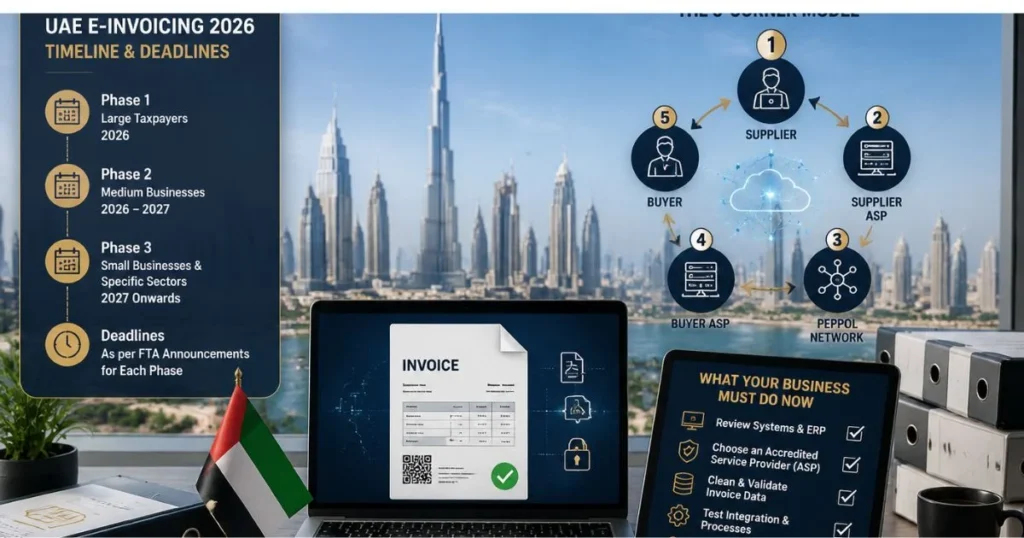
Most shop owners in Al Twar 5 don’t know e-invoicing rules are changing soon. The UAE government is moving to a phased rollout starting with bigger companies first. Your invoices must pass through an accredited service provider (ASP) before reaching your customer. This ASP checks your invoice then sends it through the Peppol network to the buyer.
We’ve helped local businesses across Dubai understand these changes without confusion or panic. Missing your deadline means facing a strict penalty structure set by tax authorities. You don’t need to fear this shift if you plan early. A little preparation now saves you stress and fines later.
UAE E-Invoicing Timeline and Deadlines
The Ministry of Finance and Federal Tax Authority jointly run the UAE E-Invoicing Programme. They are setting the pace for online invoicing. There’s no single live date for everyone.
The phased rollout means not every business switches over at once. Large taxpayers and businesses with higher transaction volumes are expected to be brought into scope first, since they have the most complex invoicing needs and the biggest impact on the tax system. Smaller businesses and specific sectors will follow in later phases, giving them additional runway to prepare.
Why Your Business Shouldn’t Wait for Its Turn
As the rollout gets closer, expect the FTA to release compliance milestones covering registration windows, testing periods and go live dates for each business category.
E-invoicing reaches into your accounting software, your ERP, your data and your team. It’s not a weekend fix. Line up your provider early, run your tests early, and get your staff trained before the deadline is actually sitting on top of you.
Understanding the UAE 5 Corner Model
The UAE’s e-invoicing system runs on the 5 Corner Model. This structure has five parties. Each party plays a clear role in moving an invoice from seller to buyer. This model routes data through checked channels at every step. It gives businesses and tax authorities a reliable audit trail.
Here’s how the UAE 5 Corner Model works. The invoice moves through five clear stages.
- The supplier creates the invoice using their accounting or ERP system.
- Supplier ASP checks the invoice. They prepare it for sending.
- PEPPOL Network carries the checked invoice across a shared exchange system.
- Buyer ASP receives the invoice. They check its format.
- The buyer receives the final, verified invoice inside their own system.
Each of these five checkpoints catches a bad invoice early. This stops problems from turning into disputes later.
Why the UAE Chose the PEPPOL Framework
PEPPOL was picked for a few clear reasons. It offers standardisation. Every invoice follows the same structure. This stays true no matter what software a business uses. It also brings security. Data moves through verified points, not open email or shared files. It supports interoperability too. Different accounting systems and ASPs can talk to each other. They don’t need custom setups for every business pair. PEPPOL already works across Europe and Australia. This gives the UAE cross border compatibility. Businesses that trade abroad get invoices recognized outside the country as well.
Where XML Invoices and API Integration Fit In
Invoices under this model aren’t PDFs or scanned images. They’re issued in XML, a machine readable format that lets systems check details like tax amounts, invoice numbers, and buyer information automatically at every ASP step.
Most providers move this data through API integration, connecting your accounting system directly to the ASP platform so invoices get created, checked, and sent without manual uploads. Businesses still running older software tend to hit this wall first, which is exactly what the next section covers.
How Businesses Should Prepare for E-Invoicing
Systems and Data Readiness
Start with your own systems first.
- Accounting software and ERP readiness: Check if your current system can create digital invoices. Many older systems need an upgrade or a plugin.
- Invoice data quality: Clean up your invoice records now. Wrong or missing tax numbers cause rejections later.
- Customer and supplier master data: Keep your customer and supplier records current. Update names, addresses, and tax numbers.
- API integration requirements: Confirm your software can connect to an ASP. Some systems need custom setup work.
Process and People Readiness
People and workflow matter as much as tools do.
- Internal controls: Decide who creates each invoice. Decide who checks it. Decide who signs off.
- Staff training matters: bring your finance team up to speed early. Help them learn how the new invoice flow works.
- Implementation planning matters too: build a simple timeline. Include dates for testing, training, and go live.
Businesses that tackle both technical and people sides move faster.
Choosing an Accredited Service Provider (ASP)
What an ASP Does
An accredited service provider sits between your business and the PEPPOL network. They check your invoice format. They confirm your tax details are correct. They send validated invoices through the network to your buyer. Without an ASP, your business cannot exchange e-invoices under this model.
Factors to Consider Before Choosing an ASP
Not all providers offer the same value. Look at these points before you choose one.
- Integration capability: Can they connect easily with your current accounting software.
- Security: Do they protect your invoice data with strong safeguards?
- Scalability: Can they handle your business as it grows.
- PEPPOL compatibility: Are they fully certified to work on the PEPPOL network.
- Ongoing support: Will they help you when issues come up after going live.
A good ASP saves you time. A poor choice creates delays and compliance risks.
How E-Invoicing Affects VAT, Corporate Tax and Audits
Impact on VAT and Digital Tax Invoices
E-invoicing changes how VAT compliance works day to day. Every sale now creates a digital tax invoice that gets checked before it reaches your buyer. This means fewer manual errors on tax rates and amounts. It also means your VAT records match your invoices automatically. Businesses that already struggle with VAT filing will find this easier once the system is set up right. Read our full VAT Pillar guide for a deeper look at VAT rules in the UAE.
Impact on Corporate Tax Reporting and Financial Statements
E-invoicing does not stop at VAT. It also feeds into your Corporate Tax reporting. Since every invoice is validated and stored digitally, your income and expense records become more accurate. This makes your financial statements easier to prepare and easier to defend if questioned. Businesses with clean invoice data spend less time fixing numbers during tax season. Check our Corporate Tax Pillar page for more on how this connects to your filings.
Impact on Audit Trails, Record Retention and Internal Controls
Every invoice moving through the 5 Corner Model leaves a digital trail. This makes internal reviews and external audits far easier. No more digging through scattered paper files or emails. Strong internal controls matter for approvals and checks. They reduce the risk of errors reaching your audit file. For expert help, see our guide on Choosing an Audit Firm.
Common E-Invoicing Mistakes to Avoid
Many businesses repeat the same errors when getting ready.
- Waiting too long: This leaves no time to fix problems.
- Using incompatible software: Old systems often cannot connect to an ASP.
- Poor invoice data: wrong tax numbers or missing fields cause rejections.
- Ignoring testing: skipping test runs means problems surface later. Problems then show up on live invoices instead.
- Lack of employee training: untrained staff slow everything down.
- Weak internal controls: unclear approval steps let errors go unnoticed.
Avoiding these mistakes early saves time and stress. It also reduces stress closer to your deadline.
E-Invoicing Readiness Checklist
Use this checklist to track your progress:
- ERP review: confirm your system supports e-invoicing.
- ASP selection: choose a provider that fits your needs.
- Invoice format validation: check your XML and API setup. Confirm it works correctly.
- Customer and supplier data cleanup: update names and addresses. Update tax numbers too.
- Tax configuration: set the right tax rates and codes.
- Internal testing: Run test invoices before going live.
- Staff readiness: Train your team on the new process.
- Compliance monitoring: Set up regular checks after going live.
For a related resource, see our Corporate Tax registration checklist.
Frequently Asked Questions
When will e-invoicing become mandatory in the UAE?
The UAE is rolling out e-invoicing in phases. Large taxpayers move first. Smaller businesses follow over time.
What is the UAE 5 Corner Model?
It is a system with five parties. These are the supplier, supplier ASP, PEPPOL network, buyer ASP, and buyer. Each checks the invoice at their step.
Is PEPPOL mandatory?
Yes. PEPPOL is the network used to exchange e-invoices under the UAE model. Businesses need an ASP connected to this network.
Who needs to comply with UAE e-invoicing?
All VAT registered businesses will eventually need to comply. Large businesses start first, and smaller businesses follow in later phases.
Will I need new accounting software?
Not always. Some systems can connect to an ASP with small updates. Others may need a full upgrade or replacement.
What happens if my business is not ready?
You risk penalties, rejected invoices, and delays in your tax filings. Getting ready early avoids these problems.
Book Your E-Invoicing Readiness Review
Deadlines are coming fast, and skipping prep costs real money. Rejected invoices, fines and last minute stress can hurt your business and your name. Assurance Corps helps you avoid this. We assess your readiness for the UAE e-invoicing rollout. We review your ERP and accounting system for compatibility. We help prepare your internal processes and invoice workflows so nothing gets missed. We also coordinate with Accredited Service Providers on your behalf. Along the way, we support your VAT, Corporate Tax, and audit readiness so your business stays compliant across the board. Do not wait until the deadline is close. Get ready now with expert support.