
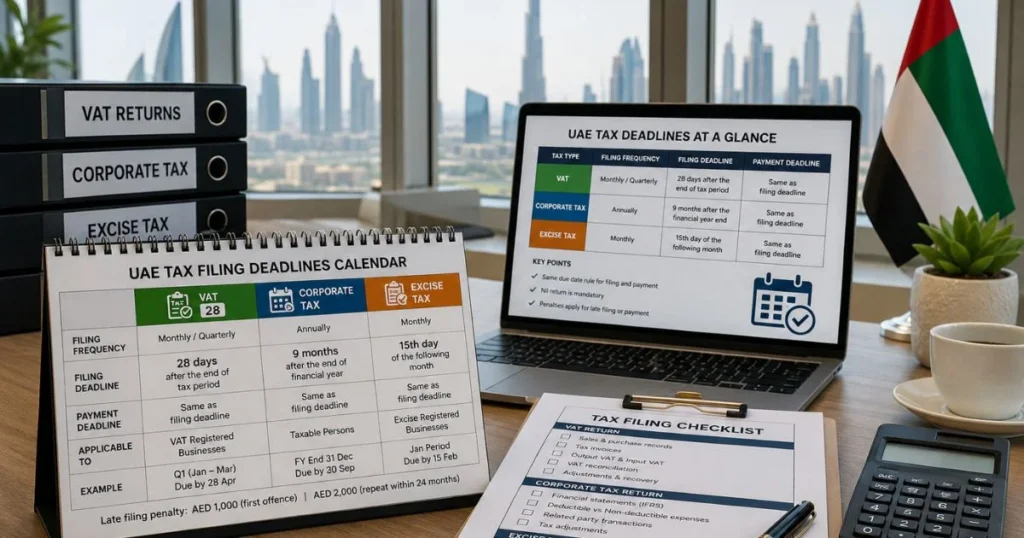
UAE businesses miss tax deadlines for one reason. VAT, Corporate Tax, and Excise Tax run on 3 separate filing calendars. A VAT registered business tracks a 28 day filing window. A Corporate Tax filer counts 9 months from their financial year end. An Excise registered business files by the 15th of every month. One missed date costs AED 1,000. A repeat offence doubles that to AED 2,000. Assurance Corps tracks every deadline across all three tax types. UAE businesses file on time and stay penalty free.
UAE Tax Deadlines at a Glance
Filing Frequency by Tax Type
The UAE Federal Tax Authority assigns a filing frequency based on your tax type. VAT monthly filing applies to high volume taxpayers businesses exceeding the AED 150 million threshold in taxable supplies. VAT quarterly filing covers standard filers below that limit. Corporate Tax annual filing follows the business financial year. Excise Tax monthly filing applies to producers and importers.
Filing Deadline Versus Payment Deadline
The filing deadline and payment deadline share the same date in the UAE. The FTA’s same due date rule means VAT return submission and VAT payment settlement fall together. Corporate Tax return submission and Corporate Tax payment settlement follow the same convergence. Filing without payment carries a penalty risk even when the Emara Tax submission is complete.
VAT Filing and Payment Deadlines in the UAE
The Federal Tax Authority assigns every VAT registered business a VAT return frequency assignment through the Emara Tax portal. Article 64 of Federal Decree Law No. 8 of 2017 sets the 28 day rule. Businesses submit VAT Return Form 201 within 28 days of the tax period end. The AED 150 million taxable supplies threshold triggers monthly VAT filing. All other businesses follow quarterly VAT filing covering periods like Q1 January to March and Q4 October to December.
Output VAT minus input VAT equals net VAT payable. The VAT payment deadline matches the VAT 201 submission date exactly. Weekends and public holidays activate the next business day rule automatically. A nil VAT return is still mandatory when no transactions occur. The AED 375,000 mandatory registration threshold and AED 187,500 voluntary registration threshold both appear on your VAT registration certificate.
Corporate Tax Filing and Payment Deadlines in the UAE
The 9 Month Rule Explained with a Worked Example
The 9 month rule sets the filing deadline calculation from the financial year end. A calendar year business with a 31 December financial year end files by 30 September. A non calendar year business with a 31 March financial year end files by 31 December. The Tax Period end starts the countdown.
First Tax Period Filing Deadline for Newly Registered Businesses
The first Tax Period follows the 7 month rule for every newly registered business. The first Corporate Tax return is due seven months after the end of the first Tax Period. An Exempt Person required to register submits an annual declaration using form CTP006. Missing this triggers an AED 10,000 late registration penalty, though a late registration penalty waiver applies in qualifying cases.
Qualifying Free Zone Person Deadline Treatment
A Qualifying Free Zone Person or QFZP follows the same 9 month deadline as all other entities. A DMCC company earning qualifying income at the 0 percent rate still meets mandatory filing regardless of rate. Failing substance requirements risks free zone tax status loss.
Excise Tax Filing and Payment Deadlines in the UAE
The Federal Tax Authority enforces a 15 day rule for every Excise Tax return under Federal Decree Law No. 7 of 2017. Each monthly tax period closes on the last day of the month. Filing opens on the Emara Tax portal by the 15th day of the following month. Excisable goods including tobacco products, energy drinks, carbonated beverages, sweetened beverages, and electronic smoking devices each trigger a separate declaration. Excise Tax registration, warehouse keeper registration, and designated zone registration determine which forms apply.
Form EX201 covers standard Excise Tax return submissions. An import declaration uses Form EX202A. A designated zone release or production declaration requires Form EX202B. A stockpiling declaration applies to goods held before the law took effect. A nil return requirement still applies when no excisable activity occurs that month. Missing the 15th day deadline triggers penalties even when the tax liability is zero.
Which UAE Tax Deadline Applies to Your Business
You Are VAT Registered
Every VAT registered business checks their VAT registration certificate first. The EmaraTax dashboard shows your monthly or quarterly assigned period. The 28 day filing window starts the day after your tax period ends.
You Are Subject to Corporate Tax
Every Taxable Person under Federal Decree Law No. 47 of 2022 confirms their financial year end from their Corporate Tax registration certificate. The 9 month filing window begins immediately after that date.
You Are Registered for Excise Tax
Every Excise registered business whether an excisable goods importer, excisable goods producer, stockpiler, or designated zone operator follows monthly filing regardless of volume.
Operate Through More Than One Legal Entity
Every UAE group structure requires individual tax registration per entity. Each separate legal entity carries its own entity level tax period. Build a multi entity compliance calendar to track every deadline separately.
Filing Preparation Checklist by Tax Type
Filing Your VAT Return
Gather all sales records and purchase records with valid tax invoices attached. Calculate output VAT and input VAT separately before starting VAT reconciliation. Include all adjustments and VAT recovery documentation alongside your taxable supplies record.
Your Corporate Tax Return
Start with IFRS compliant statements, your net profit starting point for the taxable income calculation. Separate deductible expenses from non deductible expenses inside your accounting records. Complete a related party transaction review before applying tax adjustments to your financial statements.
Your Excise Tax Return
Compile all import records, production records, and designated zone movement records first. Match your stockpiling inventory against excise transaction data for accuracy. Confirm all taxable goods information before finalising your tax calculation records.
What Happens If You Miss a UAE Tax Deadline
Fixed Late Filing Penalties by Tax Type
The AED 1,000 first offence penalty applies across VAT late filing penalty, Corporate Tax late filing penalty, and Excise Tax late filing penalty. A repeat offence penalty doubles to AED 2,000 within the 24 month lookback window. Cabinet Decision No. 40 of 2017 set these amounts the fixed penalty unchanged by 129/2025. A nil return late filing penalty applies even when no tax is owed.
Voluntary Disclosure Versus an FTA Discovered Error
A Voluntary Disclosure submitted before an FTA audit notice attracts a 1 percent per month penalty on the tax difference correction. A self disclosed error through Emara Tax Voluntary Disclosure submission carries the pre-audit disclosure advantage. An FTA discovered error triggers a 15 percent fixed penalty plus late payment interest immediately.
Staying Ahead of Your UAE Tax Deadlines
Building a Compliance Calendar Across VAT, Corporate Tax and Excise
A unified compliance calendar starts with your active tax registration list. Map each registration to its own assigned tax period per registration for full cross tax deadline visibility. A calendar reminder system prevents missed dates across all three tax types. Separate filing and payment deadline tracking entries keep each obligation visible and distinct.
When to Bring in a Registered Tax Agent
A registered tax agent with a valid TAAN handles tax agent representation directly with the Federal Tax Authority. Multiple entity management and first time Corporate Tax filer situations carry the highest compliance risk. Assurance Corps delivers EmaraTax filing preparation and completes UAE tax compliance services before every deadline hits.
FAQs
Are VAT Filing and Payment Due on the Same Date?
The VAT filing date and VAT payment date share the same deadline under the same deadline rule. Both are separate actions completed through EmaraTax. Missing either triggers a penalty.
How Is My Corporate Tax Filing Deadline Calculated?
Add 9 months to your financial year end. A 31 December year end means your deadline falls on 30 September of the following year.
Do I Need to File a Return If I Have No Tax Due for the Period?
Yes. A nil return is mandatory filing regardless of tax due. A VAT nil return, Corporate Tax nil filing, and Excise nil return all carry late penalties when missed.
What Changed Under Cabinet Decision No. 129 of 2025?
Cabinet Decision No. 129 of 2025, effective 14 April 2026, replaced the old compounding penalty with a 14 percent flat rate applied uniformly across VAT, Corporate Tax, and Excise.
Can a Tax Agent Track Multiple Filing Deadlines for My Business?
A registered tax agent uses EmaraTax agent access to manage multiple entity deadline tracking and handle filing preparation across tax types simultaneously.